I Tried Machining A Meteorite On My Desktop CNC Router
I have machined a lot of strange materials on a CNC router, but this one felt different. For this episode of Will It CNC, I bought actual meteorite material and set out to answer a simple question: can a desktop CNC router machine a meteorite into something useful?
I gave myself three attempts to figure out the bits, speeds and feeds, workholding, and toolpath strategy. The final test was the risky one. I wanted to turn a roughly 3 cm by 3 cm by 3 cm meteorite cube that cost me $300 into a functional dice.
What I Started With
I bought two pieces of meteorite material online. One was a small test piece that I could afford to experiment with. The other was the expensive cube I wanted to preserve and turn into the final project.
The challenge was obvious right away. This was not wood, plastic, or a familiar sheet good. The material was small, dense, metallic, and expensive. I needed to learn on the cheap piece before risking the $300 cube.
Attempt #1: Find a Bit and a Workholding Strategy
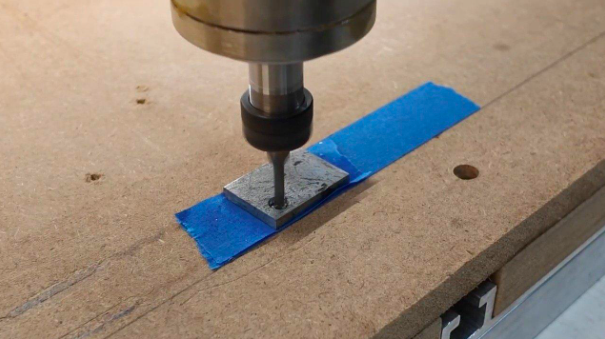
The first goal was not to make anything impressive. I simply wanted a clean cut without breaking a bit or launching the meteorite across the machine.
Because the test piece was tiny, normal clamps were not practical. I used the blue tape and CA glue workholding method. The first bond did not want to stick well because the meteorite surface appeared oily, so I cleaned it with alcohol and tried again.
For the cutter, I started with a 1/8 inch upcut bit. That first test worked. The bit survived, the cut was clean, and the edges were surprisingly sharp.
That did not prove the setup was ready for a full project, but it was enough to move on. The material was machinable, and a standard small carbide router bit could remove it cleanly under conservative conditions.
The Initial CNC Settings

These settings are starting points only. Your machine, cutter, material, rigidity, toolpath, and workholding may require different values.
Attempt #2: Machine the Perimeter and Chamfer the Edge
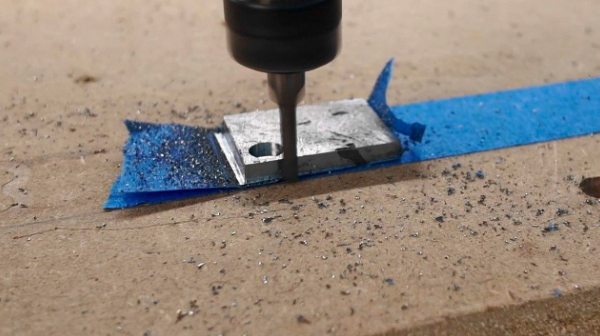
Machining farther into the sample to evaluate edge quality and chip evacuation.
The next step was to ask more of the same small sample. I kept the 1/8 inch upcut bit and machined around the outside perimeter to full depth over multiple passes. I wanted to see the machine marks, the edge quality, and how well the chips cleared.
I also experimented with air assist. One thing that stood out was that an open toolpath gave the metal chips somewhere to go. The chips were visible and distinct rather than simply packing into a closed pocket.
Could a 90 Degree V-Bit Chamfer Meteorite?
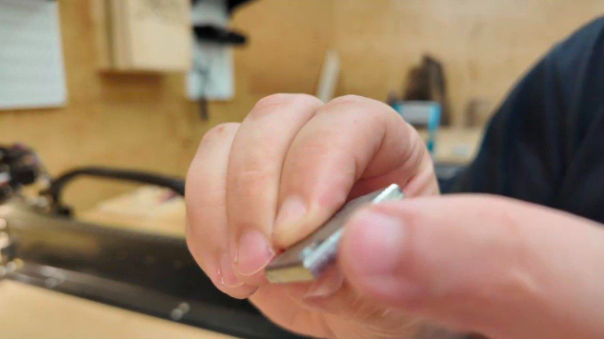
A close look at the chamfered edge after the 90 degree V-bit test.
After the perimeter cut, I switched to a 90 degree V-bit and used it as a chamfering tool. The goal was simple: knock down the sharp top edge and see whether a typical engraving-style cutter could leave a clean bevel.
It worked, but this test exposed a different problem. The CA glue and tape held, yet the sample began to flex as the material warmed up. Adhesive gets softer with heat, so the workholding became less rigid as the cut continued. A more solid setup would likely have produced an even better chamfer.
The machined edge also lost the visible surface pattern that made the meteorite visually interesting. That became an important constraint for the final project. I could square and face the cube, but doing that would remove the pattern I wanted to preserve.
Attempt #3: Turn a $300 Meteorite Cube Into a Dice
With the small sample behind me, it was time for the expensive test. I wanted to machine the larger meteorite cube into a dice. The cube already had the look I wanted, so the goal was not to reshape the entire part. I wanted to add the pips while preserving as much of the original surface as possible.
Squaring the Vise and Planning for Repeatability
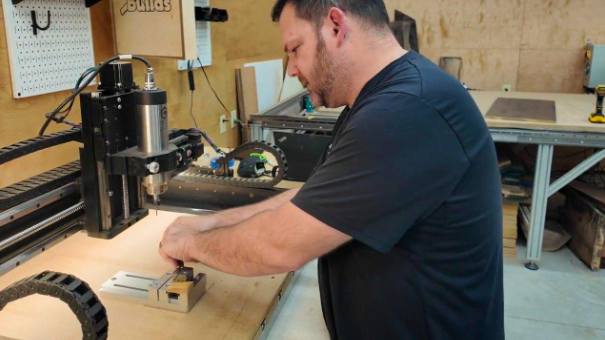
The vise setup had to be square before machining multiple faces of the dice.
For the dice, adhesive workholding was no longer the right answer. I moved to a vise and spent time getting it square to the machine. Any twist or misalignment would show up as I flipped the cube from side to side.
The next challenge was repeatability. Every face required loosening the vise, rotating the cube, re-registering it, and making sure the correct pip pattern ended up opposite the correct side. With a part this small and expensive, a tiny setup mistake could ruin the whole project.
The Toolpath Problem I Did Not Expect
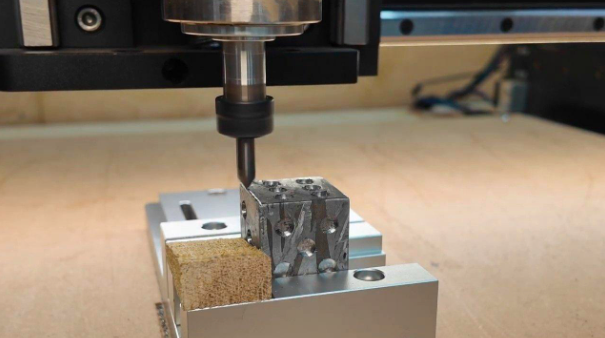
Machining the pips into the meteorite cube while it is secured in the vise.
The first pip strategy was not cutting the way I wanted. I was using a raster-style toolpath that started in the middle of a very small circle. The ramp happened in such a tight area that the cutter was effectively trying to drill almost straight down.
That is not what I wanted from a CNC router bit. The cutter needed more lateral movement so it could cut with the flutes instead of acting like a drill bit. I was also concerned that the 1/8 inch upcut bit would wear out before I finished all six faces.
The Fix: Switch From a Raster/Pocket Strategy to a Profile Toolpath
I changed the toolpath strategy so I could control the ramping better. Switching to a profile toolpath gave the cutter more lateral movement as it entered the material. That change immediately felt better and became one of the biggest lessons from the entire experiment.
The Finished Meteorite Dice
After working through all six sides, I had something I did not expect to be making when this experiment started: a functional meteorite dice. The answer to Will It CNC was yes, but with an asterisk. This material can be machined on a CNC router, but it asks a lot more from the setup than a normal woodworking project.
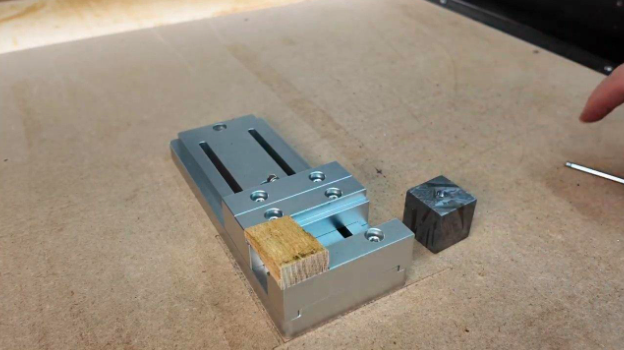
The finished $300 meteorite dice beside the vise.
What I Learned From Machining Meteorite
A small carbide upcut bit can machine this meteorite material cleanly under conservative conditions.
Workholding matters more as the material warms. Adhesive workholding can begin to flex as heat builds.
Open toolpaths can help give metal chips a path out of the cut.
A 90 degree V-bit can be used to chamfer the edge.
Toolpath strategy matters. A tight raster or pocket entry can behave too much like drilling straight down.
A profile toolpath with controlled ramping gave the cutter more lateral cutting action.
Facing or squaring the meteorite could improve geometry, but it would also remove the visible surface pattern I wanted to keep.
Multi-sided work requires careful registration every time the part is flipped.
So, Can You CNC a Meteorite?
Yes. At least with the meteorite material I tested, a CNC router could cut it, chamfer it, machine details into it, and turn a cube into a usable object.
Would I treat it like wood and throw aggressive settings at it? Absolutely not. The successful result came from testing first, staying conservative, watching the cut, improving the workholding, and changing the toolpath when the cutter was not entering the material correctly.
That is really the point of Will It CNC. The goal is not just to prove that a weird material can be cut. It is to learn what changes when we move outside the normal CNC comfort zone and find out whether that material opens the door to a project we would not have considered before.