I Tested 10 Popular CNC Router Bits to Find the Best Value
CNC router bits are expensive! So, I bought 10 of the most popular ¼ inch down cut bits to finally answer the question. Do cheap bits hold up, or are we all wasting money buying premium? Let's meet the competitors. We've got…
Temu
Eanosic
SpeTool
CMT Orange
Freud
Whiteside
Cutting It Close
IDC
Jenny Bits
Amana
So, that's our field. 10 bits enter and only one gets crowned the winner.
In round one, we'll be testing raw cut quality, a brutal showdown of edge sharpness against the unforgiving purple heart.
Round two turns up the pressure as we see how these bits wear while cutting through a variety of materials.
And if they're still standing, or rather still one solid piece of carbide, they'll face the final boss, the gauntlet. Feed rates will climb all the way up to 1,000 in per minute. Yep, you heard that right… 1,000 IPM. I've never done that before, but we're going to find out what happens.
Every round, each bit will be ranked 1 through 10 based on the judging parameters for that round. Then they will be awarded the corresponding points. For example, first gets 10 points, second gets nine points, and third gets eight points, and so on. If two bits perform the same in a round, they will tie and be awarded the same amount of points. Oh, and one more thing. Because lawyers exist, do not try this at home. Some of these settings are way outside normal ranges. These tests can break tools, damage machines, and bruise egos. Also, manufacturers, don't send me emails. Yes, under proper feeds and speeds, your bits will last longer.
Round one, the sharpness showdown. So, in this round, we're judging fresh out of the package cut quality. We're looking at the wood's edge cleanliness, wall smoothness, and overall cut finish. Here's the test setup. We're cutting purple heart, which is dense, nearly twice as hard as white oak on the Janka hardness scale. It's a bully, and I love that from round one. Each bit will take one pass, removing an 1/8 in of material, 300 in per minute. Depth of cut is 3/4 of an inch and our spindle speed will be 18,000 RPMs. Collet care and tool changes were very important. We inserted the shanks of the bits the same amount and cleaned the collet at every tool change.
ROUND #1
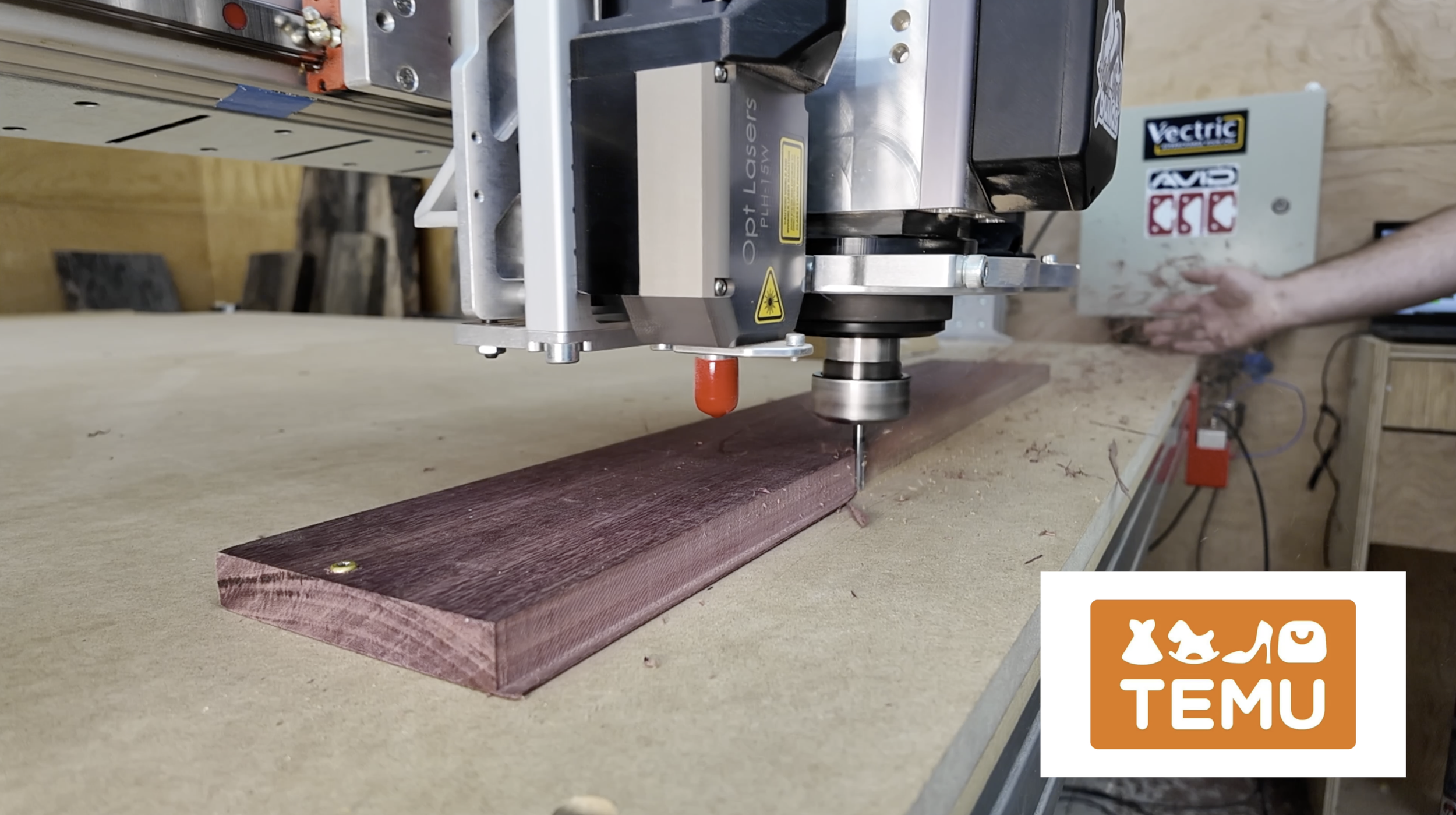
All right, Temu, you're up first. $8.36 of internet mystery. Wow, like perfectly smooth. That's number one I guess. That is pretty crazy, I did not expect that. That didn't go according to plan. The interesting thing is it looks like our bit rose up in the collet. Now, you could chalk this up to user error, but I tightened it like I tightened the one before. So, let's actually real quick, I'm going to get this off of here. I'm going to examine what happened on the other side. Is this a bit issue or is this a collet issue? I mean, if you look at it, there's nothing in that collet. The collet is not dirty. You can just see it just slipped in the shank there. All right, so after some thought, uh, we're going to chalk this up to a DNF. Not saying this is a bad quality bit, but it did not pass our test. After inspecting what we did, how we had it set up, wasn't the setup. Let's see if this next one can handle 300 in per minute in Purple Heart.
All right, SpeTool, quality cut. Not bad. Not bad. Uh, but we did have a little bit of slippage in the collet. So, it rose up a little bit. Uh, again, this is a grueling test, but cut quality wise, not bad. Just the little bit of slippage. Uh the cut is a little bit, you know, uh compared to the Temu bit, it is a little rougher. If you remember, the Temu bit was smooth. So, this is definitely worse than the Temu.
All right, Freud. Okay. Okay. Looks a lot like the CMT. You know, we've got a little bit of, if you look, like this isn't just sawdust. This is actually uncut frayed. Like I'm rubbing it hard here. Uh, and we've got some ripples in the cut here. Still not as clean as our first Temu bit.
All right. So, very interesting on the white side here. We've got a little bit of a fray here, just uncut again. But if you look where it did cut, it is much smoother. Much smoother. Uh down here, like it left a very, very smooth face. So, I'm going to put this I'm going to rank this probably second. Um still not as clean as that Temu bit. Uh but cleaner than the CMT in some ways. I'm going to say it's equal to CMT.
All right. Wow. Uh all right. It survived the test, but the cut quality is really rough. If you look, like this is uh really rough cut quality. So, still not a clean cut, but also we've got some uh some of these chatter marks here. So, I'm going to put this below uh Freud. I think this is worse than Freud.
All right. So, now we are moving into the premium bits. So, let's see. I don't know. I'm really surprised so far. The biggest surprise is Temu. Temu, which is technically LU&MA. We'll put it up on the screen. The manufacturer has let's I'm just being honest from this visual test, it has blown the others out of the water um as far as cut quality goes. So, let's see what these ones can do. Can they dethrone Temu?
Impressive. So, we've got uh it's very clean. Very clean all the way through here, through here, through here. I mean, you can see a little bit of chatter ripple here. So, overall, really, really clean. I think just this little area right here, we had a little bit of uncut, just fray, uh where the cut wasn't super clean. But overall, I would say this is probably our second best so far.
All right. All right. Jenny bit. You look we maybe have a little more fray like left behind here, but very very similar. And uh you look right here, it's very smooth. like there's no hard uh cut lines in the cut here. Um maybe a little more fray left behind, but still very solid.
All right. So, Amana we got here. We got very limited chatter lines here. Very, very clean. Uh we do have some fray here. You can see like frayed cuts. Uh but not horrible. I think it's very similar to IDC Woodcraft. Uh so I'm going to put it in the same line as IDC.
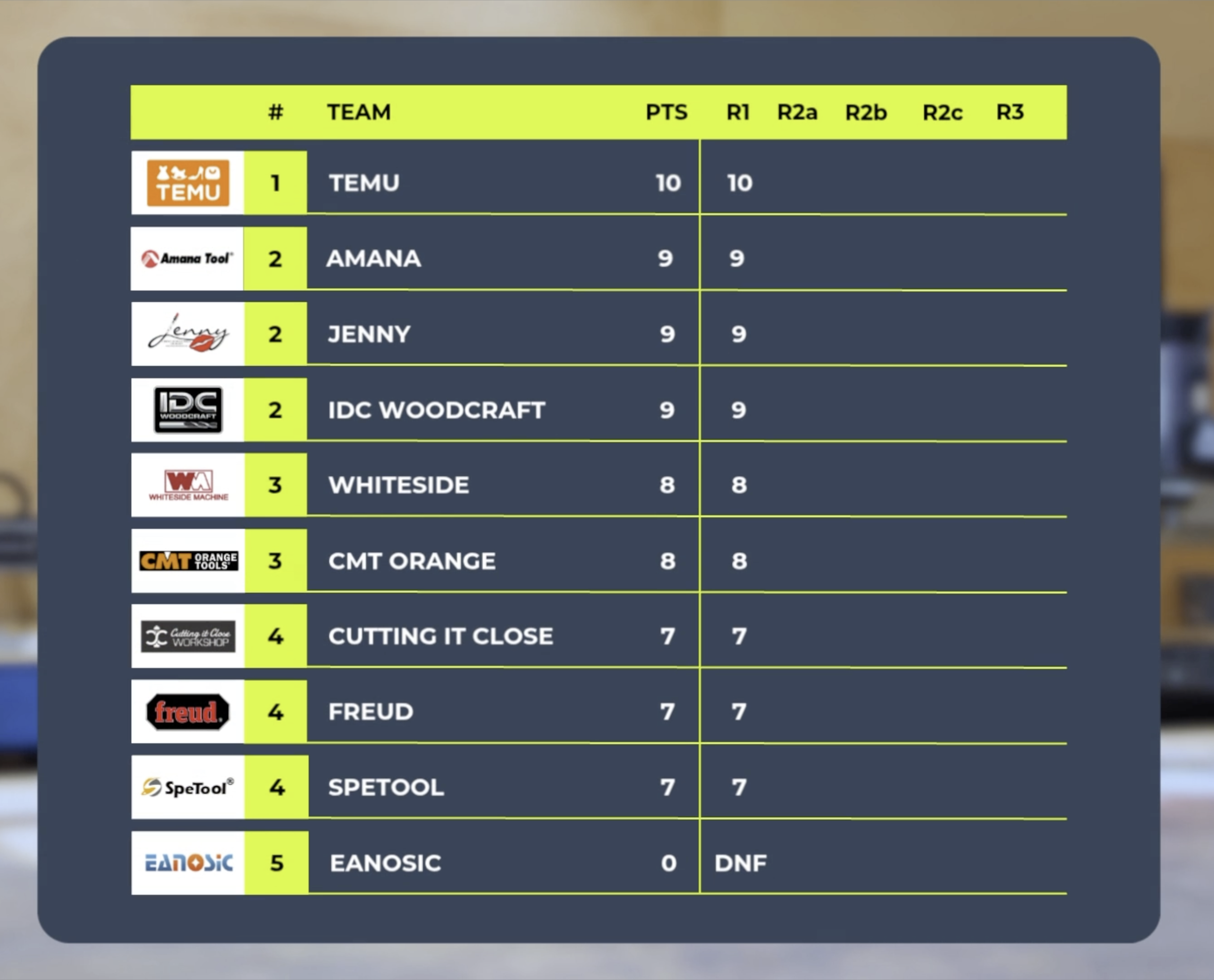
Here's the scoreboard after round one. Temu surprises early with clean purple heart cuts. Could we see Temu upend the entire CNC bit market? Eanosic is out. The usual suspects at the top of the leaderboard. Amana, Jenny, IDC all look composed.
ROUND #2
All right, let's move on to round two, the endurance battle. This round is about longevity. How much use a bit can take until we start to see it break down. Test number one in this round is noise while cutting because noise equals friction, which equals dulling, means a duller edge. Test number two is cut quality at the end of each test set. And test number three is microscope inspection for edge rounding and microchipping. So we run every bit through three escalating tests. Trial A is pocketing in plywood for 1 hour. Trial B is slotting in white oak with chip load intentionally reduced to build heat. And trial C is slotting in MDF, further intentionally reducing chip load in this abrasive dust maker that loves to cook edges.
All right, test number one, plywood pocketing. 10 bits, 1 hour each. Same pocket routine, just normal feeds and speeds. We want to just put the bits through their paces here and get some wear on them. Nothing exciting to report. Everyone passes with no issues and no noticeable wear. This tells us that even budget bits can get work done without drama when settings are reasonable and cut times are limited.
All right, test two. White oak slotting with a low chip load to create heat. Here we stack the deck against the edge on purpose. We slow the feed and raise the RPMs to 20,000. So low chip load equals rubbing. Rubbing equals heat. Heat is a great way to reveal weak coatings or soft carbide. The results, every bit passed. No cracks, no drama here either. Let's move on to test number three. MDF is the tool eating boss level. It isn't wood, it's glue and dust. It grinds more than it cuts. So, it's the perfect material to try and expose weaknesses in these bits. But honestly, every bit took the test on the chin and carried on. I did notice Temu’s bit cut quality struggling. Ragged edges, fuzzy tops. The early Cinderella story might be losing its lead here.
Everyone else seems to be doing okay. Let's judge the results of this round and see where they land. First up, noise. I logged the highest decel recording for each bit on its first two slots. Here are the results of the noise trial. With Temu being the lowest, I did not expect these results. But the decibel reader was set in the same location. The decibel reader doesn't lie. Next, we judge cut quality. Remember that these are down cut bits, so we shouldn't see any frame on the top edge. But SpeTool and Amana had the cleanest looking cuts. Look at SpeTool coming out of nowhere.
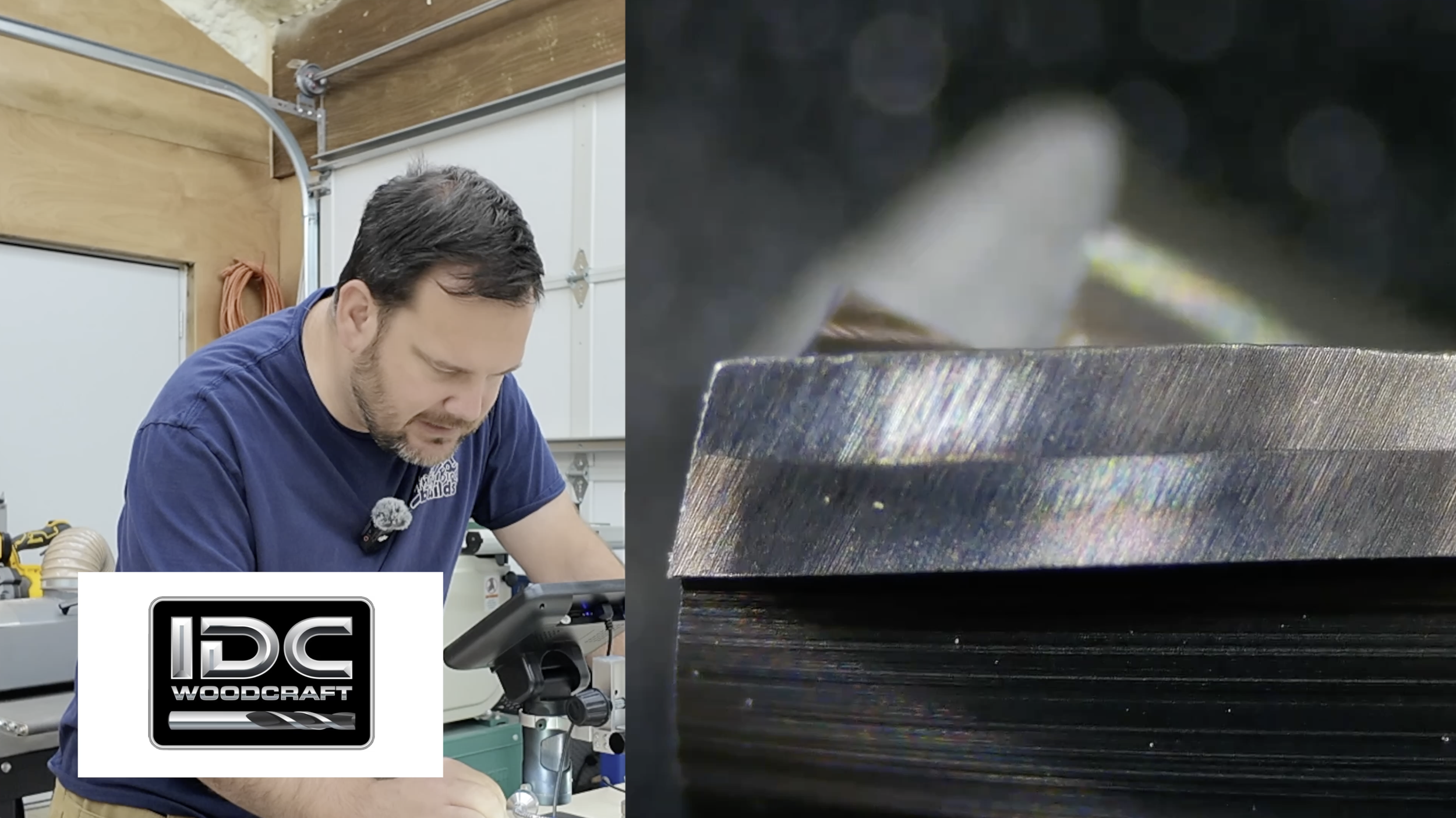
Then we headed to the microscope. First bit up, Temu. All right, we're just looking for edge rounding and kind of micro cracks here. What the heck? This isn't a downcut bit. Temu sent me an upcut bit even though I specifically ordered a down cut bit. I went back and checked my order. I ordered a down cut bit. You know, it cut cleanly on that purple heart test, but it's an up cut bit. So, it wasn't the geometry that changed what those cut results were going to look like. So, I'm disappointed. Disappointed in this. Temu tried to Lance Armstrong this competition. And for that, Temu, you're disqualified.
All right, next up, SpeTool. I can confirm that SpeTool is a downcut bit. All right, let's see what we've got here. A little bit of edge deterioration starting. You can see the shiny there starting to round over.Overall, not bad. Still a really crisp edge. Obviously, there is some rounding, but it's holding its shape. Holding its shape really well. But we do have a little bit of edge deterioration. Nice, Freud. Uh there's a little bit there down on the edge down on the corner, but you can see the overall edge still has the grind marks on it from sharpening. A little bit of edge deterioration. Okay, Whiteside is still holding those grind marks. Edge rounding is starting to happen. Here's a big chunk out of it right there. That's interesting. See that big chunk right there in the middle of the screen. Okay. None of the other ones had that. All right.
Now we're going to get into some coated bits. This is the Cutting it Close bit. And so um we'll probably see a couple different things. Whoa. Hang on a second. Look at that. Uh, what I was going to say is with a coating on them, you should get a little uh better heat dissipation and um shouldn't be as much wear, but that was just my guess. You can tell that this edge is is by far the worst there. Let's look at this other cutting edge. Same thing. I mean, it's uh has taken a beating. All right. So, we see a little bit of edge deformity happening there. But you notice how the edge is not almost like disintegrating. Now, that's the edge is not disintegrating on any of these bits. I'm just describing what it looks like under a microscope. Um, it's still holding its cutting edge. Yeah, it's worn. It's a little bit rounded, but it's still holding it. It's the first time we've seen that.
Again,some of the shadows here as you as I roll it here, you can see the shadows. So, don't be fooled by those. But overall, I think this is the best one so far. All right. So, we've got some edge deterioration here.Uh, but overall it's wearing equally. And just remember, all these bits have gone through the same exact two hours of testing. Now, Amana is the only one that we have here with this dark blue and purple coating. So, it's going to look worse under a microscope. Um because it's losing that coating, it's really going to stand out. But let's look for uniformity. You see a couple nicks there.The edge is not browning. That's just the coating. So it's not burning. Uh overall looking at the edge, it is wearing, but it is consistent.Yeah, I think this is the best one. Really is. It's consistent. It's better than IDC. Um, it looks good.
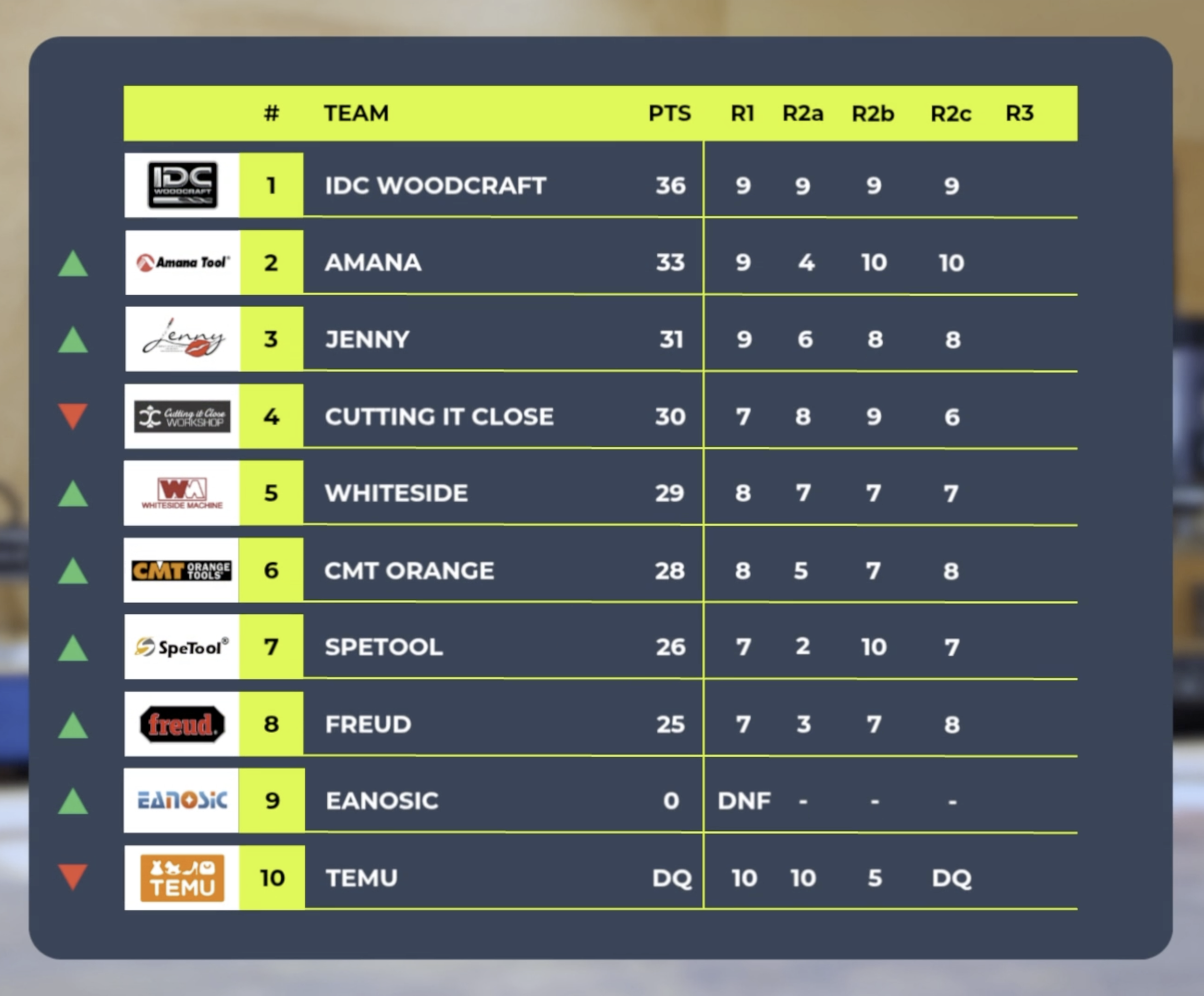
And here are the results of the microscope grading. So, here's the leaderboard after round two. Eanosic exited early in purple heart. Temu is DQed for being the wrong bit. Eight bits remain in the fight heading into the last and most brutal test.
ROUND #3
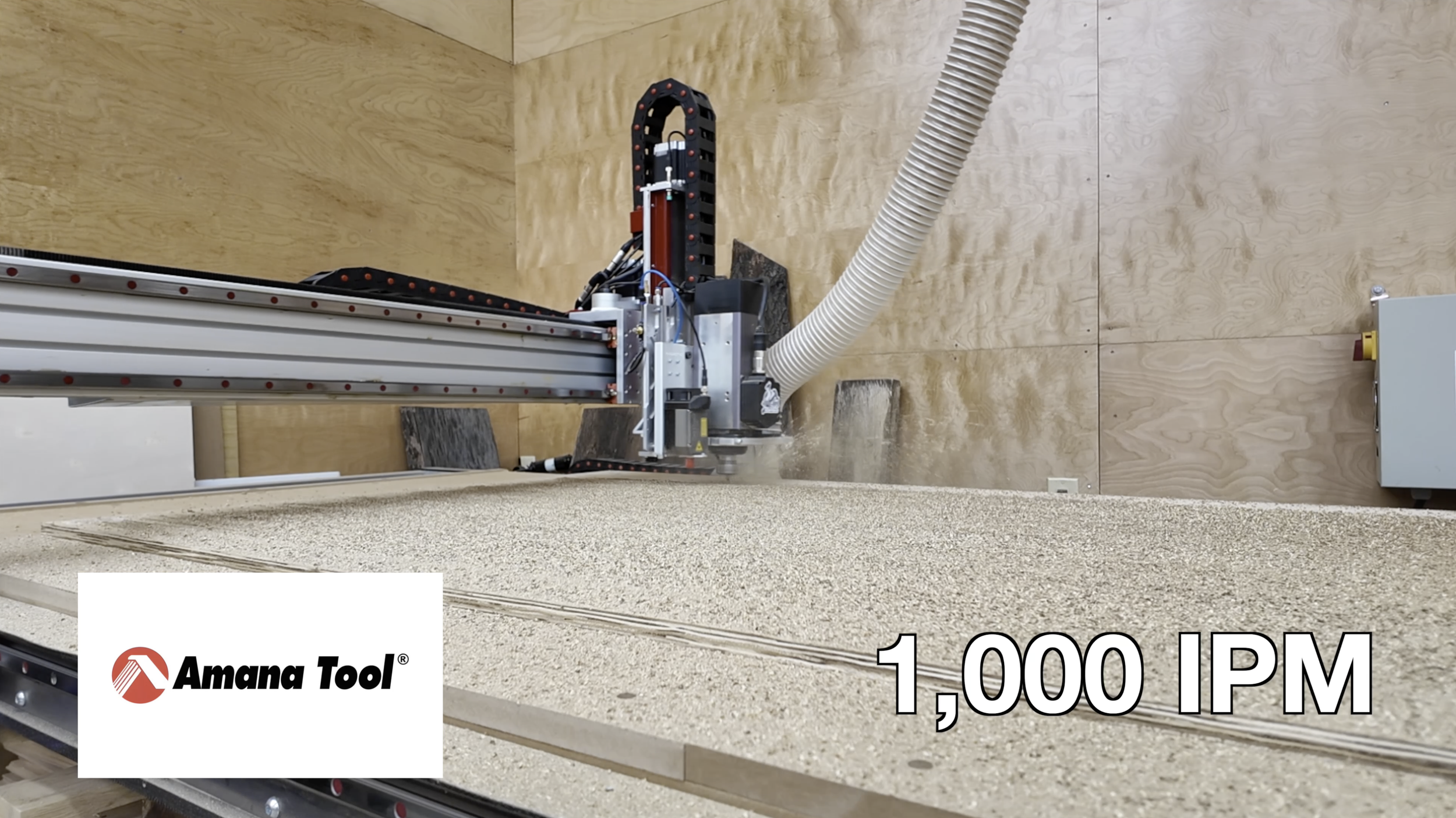
So, round three, the gauntlet. Here's what we're judging. Toughness under extreme stress. The question is simple. Did the bit survive the sequence? We will measure and rank the bits based on how far they got. The most points a bit can get in this round is 10 plus a two-point bonus if they finish the course without breaking. We're going to be running passes in plywood at 5/8 of an inch depth of cut with the spindle at 24,000 RPMs. Five passes per bit back to back with speed escalating. Pass number one is 30 in per minute. This is the painful crawl. almost no chips, a lot of friction, and a lot of heat. And then right after that, we're going into 400 in per minute. And then we're going into 600. And then we're going to go into 800. And then if it's still not broken or something isn't broken, we're going to push it all the way up to 1,000 in per minute at 24,000 RPMs.
So each bit will go through this five pass sequence until it breaks or survives. All right. Let's see what happens. From the slow crawl to 1,000 in per minute, my butt cheeks kept getting tighter.
All right. So, the CMT bit, the CMT orange bit that we got from Menard's locally finished the test. It finished the gauntlet 1,000 in per minute. Didn't break.
Freud is hot. Well, we broke a bit on the thousand inches per minute. Freud snapped. So, sorry Freud.
White side survived the gauntlet 1,000 in per minute. It didn't flinch. Didn't flinch.
All right. Rooster tails and all. All those chips flying out Cutting it Close passed the Gauntlet.
Another one passes the gauntlet. I'm seriously impressed. I'm seriously impressed. This, I think, just reinforces that most bits are broken when something goes wrong, not when you're making a linear pass. That's what I'm finding. Carbide is tough.
All right, Jenny. Jenny did it. 1,000 inches per minute after 30 in per minute at 24,000 RPM. Throwing them chips.
All right. Amana. Amana. Amana. She passed the test.
All right. We tallied everything up and the champion of this CNC bit battle with 48 points is IDC Woodcraft.
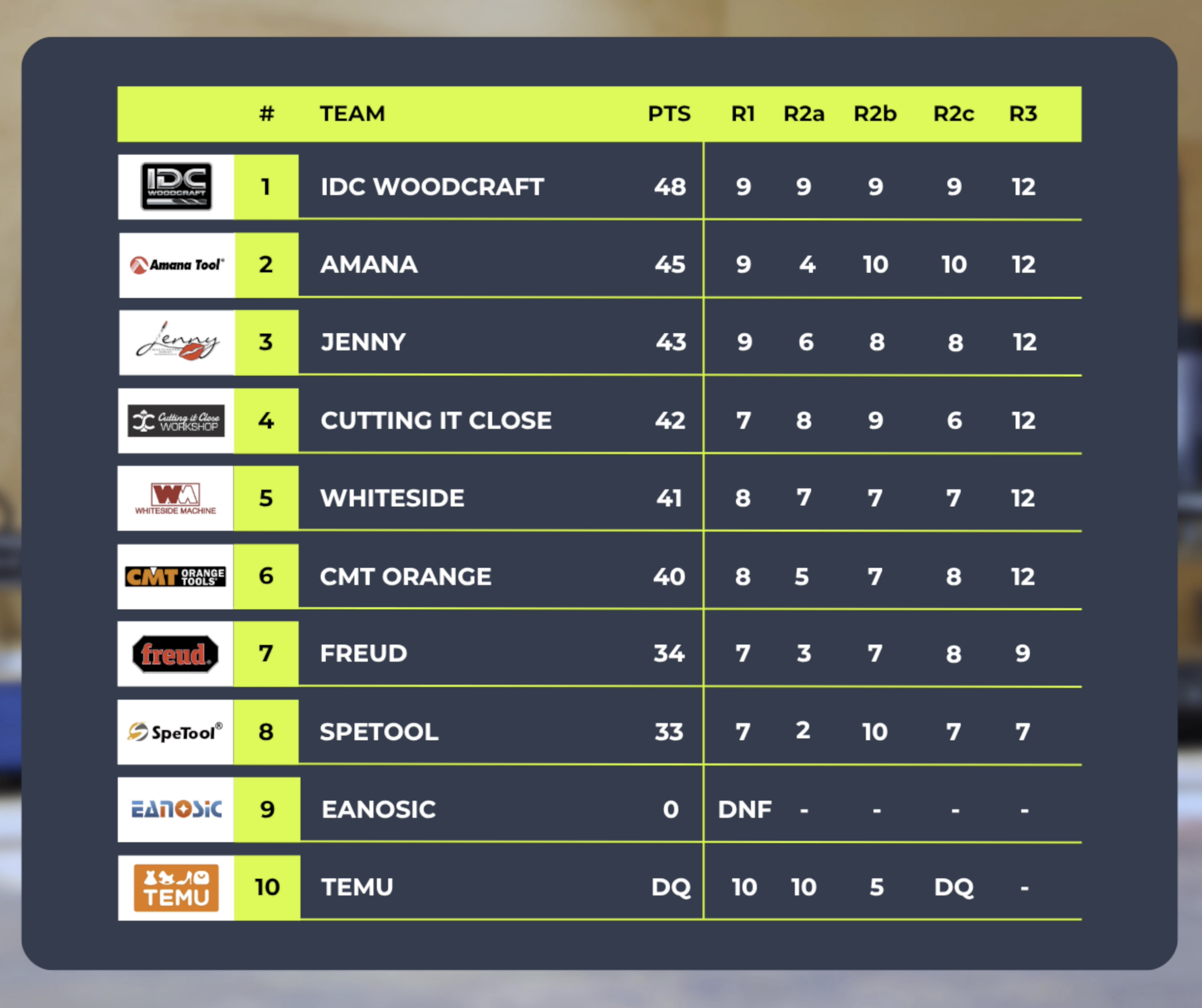
So, back to my original question. Do cheap bits hold up or are we all wasting money buying premium bits? Well, I think from our not so scientific test here, the cliche, you get what you pay for, mostly holds. The pricier bits generally perform better across clean cuts, endurance, and the gauntlet test. But that's not the same as saying buying premium is always the right answer because your use case matters. What these tests really revealed to me is that carbide is really hard to break. Seriously, it reminded me that most bits break from setup errors and not speeds and feeds.
So, if you're new or trying a risky tool path or dialing in workholding for the first time on a weird shape, use the budget bit. Crash the inexpensive one in cheap material. Learn on it. Break it if you have to. Eight bucks hurts a lot less than 36. But when cut quality and efficiency matter, or when you're carving the last pass on something that's headed straight to a client, that's where premium bits earn their price. Geometry, carbide quality, and coatings show up in production settings and the final product. I think if we were to keep going with these tests, we would start to see the bits separate themselves. We started to see that, but I think it would just become more evident the further we went into the tests.
If you take nothing else from this video, just remember you probably can run your bits faster, way faster than you think. Seven of these bits topped 1,000 in per minute. That is absolutely wild. I had no idea if it was going to work. Now, jump into the comments and let me know your thoughts. I know some of you are already there. If feeds, speeds, and chip load feel like alphabet soup, that's literally what I teach step by step in the CNC kickstart. It's designed to keep you from doing what I did as a beginner, buying the most expensive bit and snapping it on day one.